Blog
Battling Brainrot: A High School Student Presents Her Unique Intervention to 150+ Researchers and Clinicians
By Stephanie Leung
High School Winner, Child Mind Institute 10-Minute Challenge
I still can’t believe I presented the concept of brainrot and “chimpanzee bananini” to over 150 researchers and clinicians at a psychology conference in Chicago.
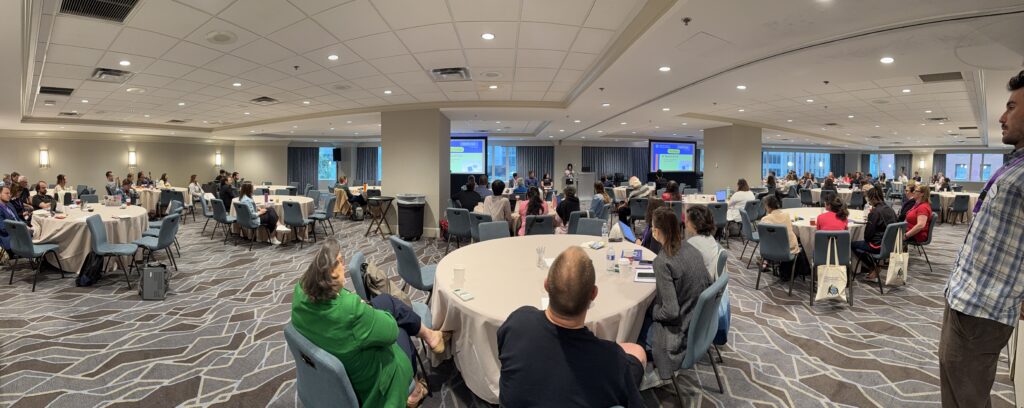
Last month, I was invited to speak at the “5th International Single Session Therapies Symposium (SST5)”, presented by the Lab for Scalable Mental Health, as the high school winner of the Child Mind Institute’s 10-Minute Challenge. I designed my own digital intervention using the Child Mind Institute’s research platform Curious to address an issue I’ve personally struggled with — developing a healthy relationship with technology — and to support other youth like me. To be able to discuss my work with field-defining researchers at this event was an incredibly rewarding experience I’ll never forget.
The inspiration for intervention
“Brainrot” is defined as the supposed deterioration of a person’s mental or intellectual state, especially from the overconsumption of non-stimulating content. But on a larger scale, the rise of brainrot is a reflection of the current digital ecosystem in which youth from both Gen-Z and Gen Alpha are often involuntarily immersed. Now, with algorithms and AI beginning to dictate what we should consume in all aspects of media, youth are increasingly exposed to useless and non-stimulating content.
Parents and adults often misunderstand that we, as youth, are not zombies completely unaware of the reality and impact of excessive screen time. Many of us have at least some awareness of how this online ecosystem can make us feel: tired, powerless, and even angry at how these algorithms are “rotting” our primal brains. The popularization of the term brainrot mirrors our collective recognition that the superficial content we compulsively consume does not fulfill us emotionally or intellectually.
But here lies the issue. As youth, we are more aware than ever of our unhealthy relationship with technology and digital media. But we are not empowered with the tools and skills needed to reclaim our agency and use technology for good.
Developing my intervention
Now to be honest, my own daily phone screen time is about four hours. This is an issue I’ve been struggling with for a while. So, when I came across the 10-Minute Challenge earlier this year, I felt excited to be given the opportunity to tackle this issue. And as a student in the Youth Mental Health Academy’s second cohort, I’ve already been involved in one of the Child Mind Institute’s initiatives to promote open-access research and diversify the field of psychology. This work felt like an extension of that.
During the research process, I came across Angela Lee and Jeffrey Hancock’s research on social media mindsets as part of the Stanford Social Media Lab. Within their research, they discussed the belief that technology and social media can be used as a tool to promote our well-being. They also found that social media mindset could be the strongest predictor of reduced psychological distress, compared to other measures like duration or intensity of use.
Fascinated by this idea, I wondered if our approach in solving the problem of brainrot has been wrong all along. What if instead of shaming or restricting technology use, we can empower youth to take back agency and use technology to fulfill their goals?
Through my single-session intervention — an online self-guided, open-access program designed to be completed in 10 minutes or less — I aimed to empower youth by introducing this concept in an accessible, interactive way.
The results
The Child Mind Institute is currently conducting a longitudinal pre-post study validating three Single-Session Interventions (SSIs) from the 10-Minute Challenge, including mine.
From the initial validation studies, which assessed the social media mindsets of 105 young adults ages 18 to 25, before and immediately after using my intervention, we can see early evidence of the positive impact of this SSI on social media attitudes. These early results support healthy relationships with technology.
On the valence subscale — assessing how positive an individual views social media — we did see a statistically significant score increase of 0.59 points, pre to post intervention.
On the Agency Subscale of the Social Media Mindsets Scale, which assesses how “in control” the participant feels towards social media — though it is non-statistically significant — we see an increase of 0.34 in the average score from pre to post intervention.
There is strong feasibility and acceptability, with 90.5% of participants finding it easy to use and an astounding 93.3% finding it useful. After using the intervention, participants reported improvement in understanding adaptive vs. maladaptive technology use and more confidence in setting boundaries.

Final thoughts
My intervention is only a small fragment of a larger movement of single-session therapies and interventions that can provide critical, accessible mental health care and support to those who face financial, physical, and cultural barriers to care.
At the symposium, I was incredibly inspired by the presentations of clinicians and researchers, especially Jessica Schleider, PhD. They expanded my view of what mental health care can look like in the future. I’m so excited to continue my advocacy for accessibility in mental health.