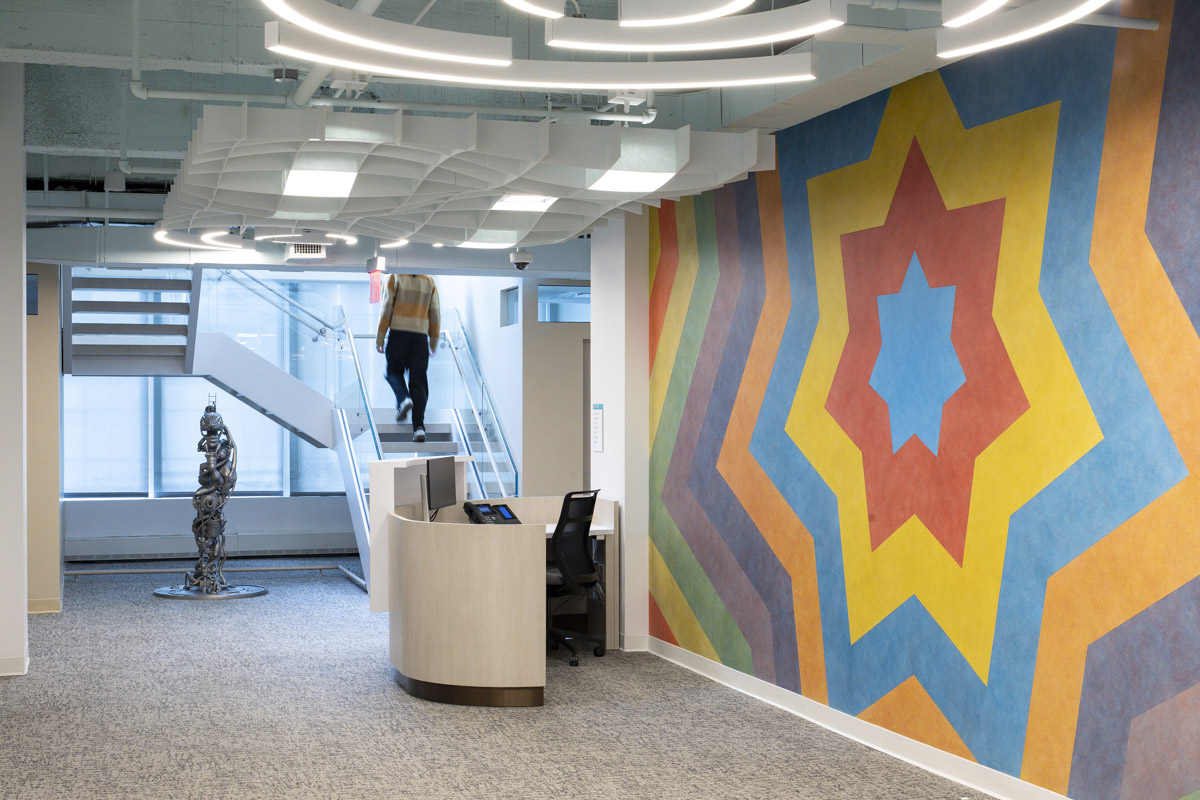
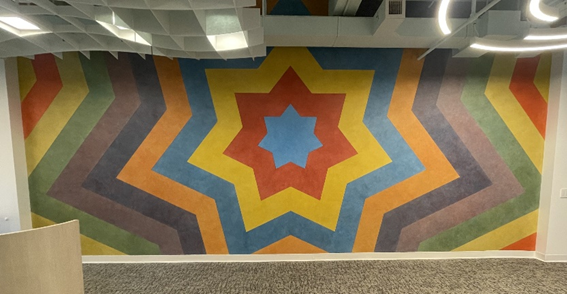
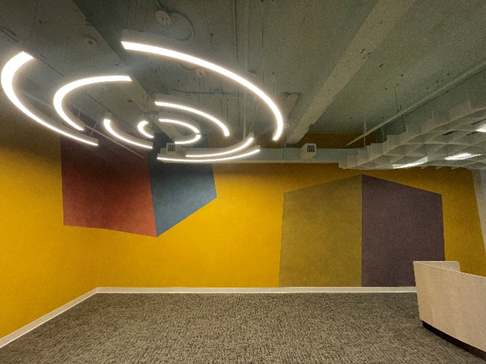
Wall Drawing #691, Wall Drawing #784
Acrylic paint
Long-term loan through RxArt
On Display
Second floor, elevator lobby
About the Artwork
Wall Drawing #691, Wall Drawing #784 Timelapse
Artist Biography
Sol LeWitt (1928-2007) was an American artist widely recognized as a leading figure in the development of Minimal and Conceptual art during the mid-20th century. Born in Hartford, Connecticut, LeWitt’s innovative and influential contributions to the art world have left an enduring legacy.
His work often featured geometric shapes and simple forms, exploring the relationships between color, shape, and space. One of LeWitt’s defining characteristics was his commitment to the idea that art could be conceived as a set of instructions rather than a physical object. This concept is evident in his renowned “Wall Drawings,” a series of large-scale, site-specific artworks where LeWitt provided detailed instructions for their creation, allowing different individuals or teams to execute the work. This approach challenged traditional notions of authorship and emphasized the importance of the conceptual framework behind an artwork.
Sol LeWitt’s influence extends beyond his artistic output; he was also a prolific writer, and his ideas on art and creativity continue to resonate in contemporary discussions. Through his dedication to conceptual art and his exploration of systematic processes, Sol LeWitt made a lasting impact on the trajectory of modern and contemporary art.
About the Art Program
In January 2024, the Child Mind Institute moved its headquarters to a new 82,000-square-foot space in Midtown Manhattan. From the beginning, our new home was envisioned not only as a place for clinical care and research, but as a space that feels comforting, human, and inviting for children, teens, and their families. In order to support this vision, CMI established a comprehensive Art Program to foster meaningful engagement between our patients and the artwork around them. Through a thoughtfully curated permanent collection and integrated installations, the program helps create an environment that is stimulating, flexible, and collaborative —a space where we will help tens of thousands of children from 49 states, Washington, DC, and 45 nations over the coming decades and inspire current and future scientists to change the child mental health field as we know it. We hope that the digital archive will give patients and their families further opportunity to explore the collection and learn more about the talented artists that have contributed to our space.