Blog
From Pelican Cases to Protocol: Building Two MoBI Labs in Brazil
A very specific kind of adrenaline comes with traveling internationally when your checked bags contain sensitive scientific hardware.
When fellow scientific software engineering generalist Nicole Burke and I landed in São Paulo, Brazil with three standard suitcases and two massive Pelican cases housing our computer towers, we knew we were in for an adventure. Our mountain of gear looked more suited to an expedition than a standard flight! We garnered more than a few raised eyebrows when collecting our things at baggage claim, needless to say.
After playing a high-stakes game of real-life Tetris (which I love!) to fit our luggage into a single Uber, we set off on our mission — to build two brand new Multimodal Brain/Body Imaging (MoBI) labs in Brazil and train local teams to run them independently.
The MoBI Lab is built to capture the brain activity, eye movements, heart rate, body motion, voice, and handwriting of our young participants while they complete cognitive and emotional tasks. The goal is to build better, more accurate mental health assessments for children and adolescents while combining the deep expertise of local partners in their own communities around the world.
First Stop: Sao Paulo
After arriving in São Paulo, the first of two destinations on our journey, we got started right away on setup in the Institute of Psychiatry at the Hospital das Clínicas of FMUSP. This consisted of two full days of unpacking equipment, navigating the tangled web of hospital Wi-Fi networks, and turning one empty room into a fully functioning research space.
But this build was more than just a logistical challenge. It was a real-world stress test for the international documentation we’ve built at the Child Mind Institute.
We leaned heavily on our online, open-access documentation to confirm our configuration was spot-on. This is what open science is all about. Having reliable, transparent documentation means technology developed in one corner of the world can be seamlessly replicated thousands of miles away.
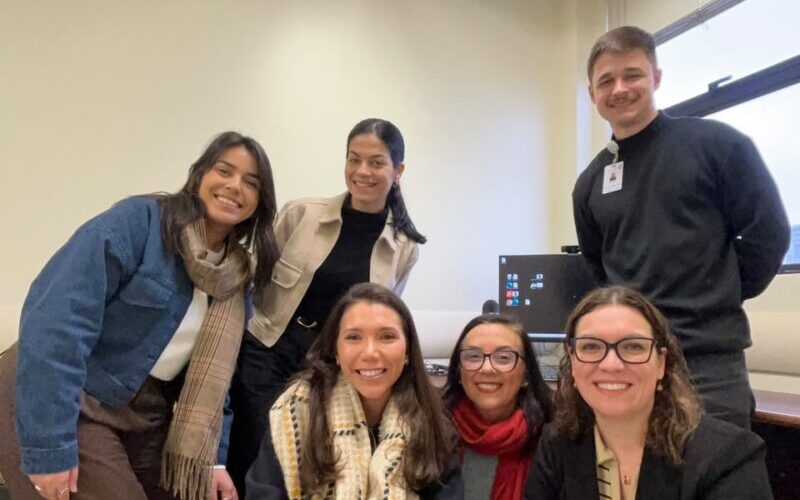
Once the hardware was in place, the more important work began — knowledge transfer. We kicked things off with presentations introducing the MoBI lab and the Child Mind Institute’s broader mission to strengthen child and adolescent mental health systems. And we explained that through the Stavros Niarchos Foundation (SNF) Global Center, we’re able to work alongside local partners to translate scientific evidence into practical, scalable solutions. We also presented the Healthy Brain Network — one of our landmark studies that’s designed to identify biological markers of childhood mental health and learning challenges, while providing families with crucial insights into their children’s developmental needs, connections to care, and access to school-based accommodations.
Convening in a gorgeous library inside the Institute of Psychiatry, Nicole and I taught local implementation partners how to place an electroencephalography (EEG) cap securely onto their participants. Back at the lab, the São Paulo team was quicky brought up to speed on the full protocol. And by the end of the week, the cables were neat, the room looked great, and everyone was ready to get started!
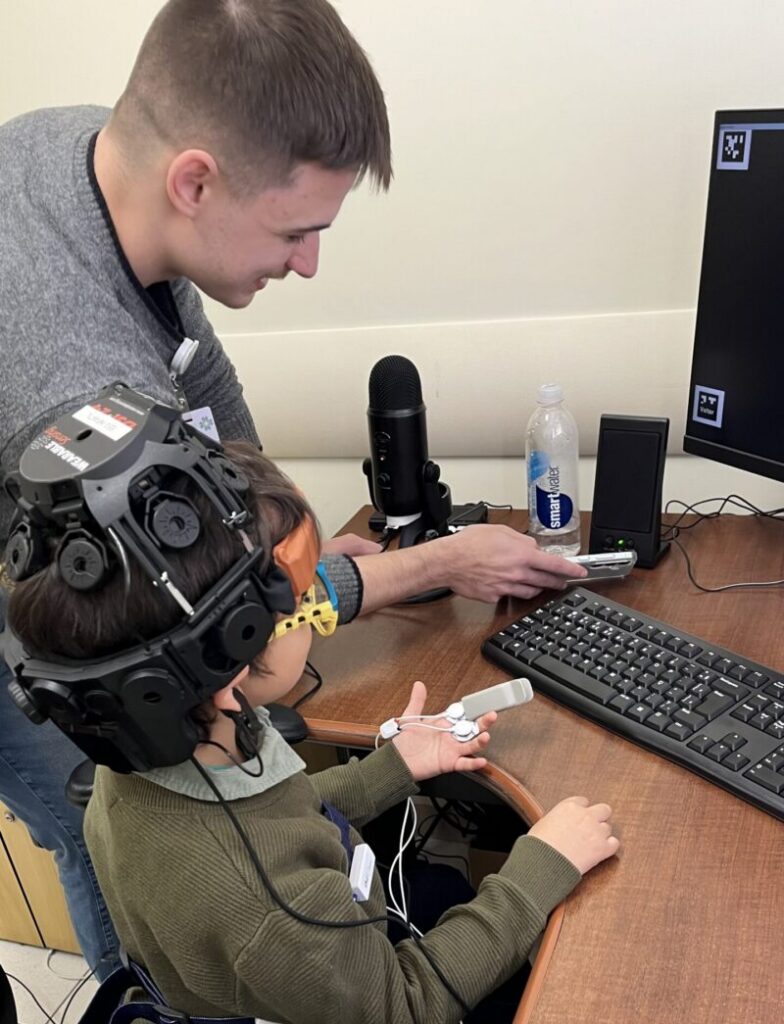
As our trip came to an end, we had already watched the recently trained team run their first protocol with a real participant. To top it all off, a local news crew reached out to them to film a segment on our project. Watching our equipment get featured on TV Cultura and sharing how MoBI helps ensure high-quality data across various research protocols was a fun way to close off a whirlwind of a week.
Next Stop: Porto Alegre
After eating great food, experiencing wonderful hospitality, and watching the World Cup together, it was time to say our goodbyes and head to the next destination.
I traveled to Porto Alegre to build the second lab. Using everything we learned from the first build, I set up the equipment, trained the team, and had the lab ready just in time for the first participant.
Porto Alegre is my hometown, so having the opportunity to build a state-of-the-art MoBI lab right where my own story began feels like coming full circle. It’s deeply personal.
For a long time, advanced scientific infrastructure has been concentrated in just a few places around the globe, meaning local researchers often had to move away or work with limited resources. Setting up this lab in Porto Alegre changes this equation by equipping our local scientists with world-class tools, creating opportunities for young Brazilian researchers, and ensuring our global datasets represent diverse communities instead of just one corner of the world.
A Foundation for What’s Next
Building these two labs in just a couple of weeks was intense, but incredibly rewarding. The energy and commitment of the teams in São Paulo and Porto Alegre made the experience even more meaningful. And seeing the labs take shape through their expertise, collaboration, and local leadership brought a real sense of shared ownership.
This is also a reflection of what we’re working towards at the Child Mind Institute:
- Making research tools and knowledge more accessible
- Strengthening local expertise
- Creating opportunities to advance child and adolescent mental health research around the world
For me, the most rewarding part of the trip was knowing that these teams are now equipped to lead this work independently and continue advancing meaningful research long after we’ve returned home.