Blog
The Young Brazilians Creatively Shaping Healthier Digital Habits
What happens when youth are invited to design solutions for healthier technology habits? Meet the three winners of a nationwide competition in Brazil, launched in partnership with the Felipe Neto Institute, and learn about their winning solutions.
Young people have invaluable perspectives on the mental health challenges facing their generation. They also have ideas on how to effectively address these concerns across contexts. To help elevate those ideas, the Child and Adolescent Mental Health Initiative (CAMHI) in Brazil — under the Stavros Niarchos Foundation (SNF) Global Center for Child and Adolescent Mental Health at the Child Mind Institute — partnered with the Felipe Neto Institute to launch the nationwide challenge, “Bem na Rede: Competition for Healthy Technology Use.” The competition invited young Brazilians ages 16–20 to share their vision for advancing youth mental health.
Three winners were selected: João Marcos Almeida dos Santos, who secured first place with his project “Libélulas” (Dragonflies); Lindaiane de Souza Santos, who won second place with “Troca de Piloto” (Pilot Switch); and Larissa Thomas Martins de Siqueira came in third place with “TRANSFORME” (TRANSFORM). The winners received BRL5K ($966 USD), BRL4K ($775 USD) and BRL3K ($579 USD), respectively.
We spoke with these young changemakers to learn more about the inspiration behind their winning ideas, the challenges they hope to address, and what meaningful change looks like to them.
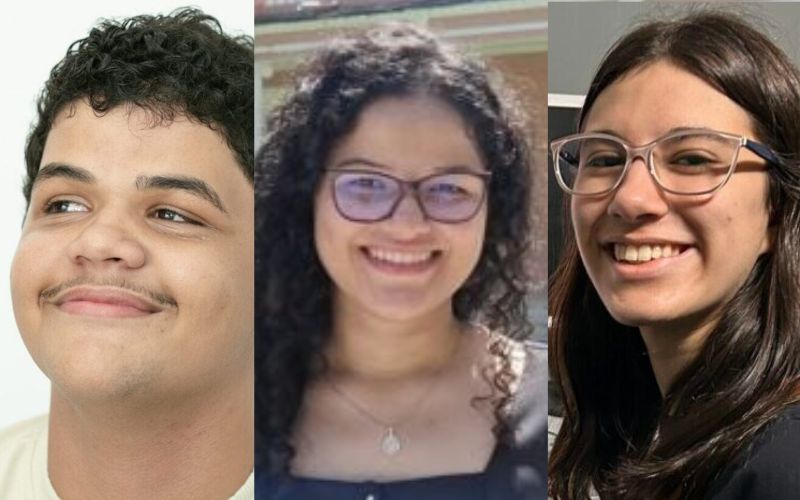
Second place competition winner, Lindaiane de Souza Santos
Third place competition winner, Larissa Thomas Martins de Siqueira
Youth perspectives on the challenges of a digital age
Lindaiane: On social media, we often see only a snapshot of people’s lives and compare ourselves to them. So whenever we see a photo, we need to remember that you cannot compare an entire life and all of a person’s struggles with a simple social media post or a one-minute video.
João: Social media functions like digital fast food: the endless feed, algorithms, and comparison culture can create an addiction in which the brain constantly craves more stimulation, which could generate ongoing anxiety. For many young people, this has become “normal,” but the impact on development and social relationships is alarming.
Larissa: The algorithm is designed to capture our attention, creating endless scrolling and an emotional escape from everyday stress. In the long term, however, the result can be addiction, comparison, and anxiety — an especially harmful scenario in countries where young people face significant mental health care challenges.
The winning solutions
João, “Libélulas” (Dragonflies), 1st place: The project focuses on prevention, helping young people deal with their emotions before pressure from the digital environment develops into more serious conditions, such as depression. At the end, the user receives not only an assessment but also a tool for transformation. They come to understand that, like a dragonfly, they must leave unhealthy habits behind in order to embrace a new phase. The goal is not to abandon technology, but to build self-awareness — learning to use it in ways that support our well-being while maintaining resilience and self-care, both for ourselves and for those around us.
The intervention proposes a journey of conscious self-reflection. In one of the forms, I invite users to answer the question: “Describe a moment in your life that marked a change between who you were before and who you are now.” Users are also encouraged to create a list of activities away from screens, without pressure.
As a young person, I also know that nobody wants to read long texts or answer only “yes” or “no” questions. That is why I used accessible language and an appealing design, with short questions that genuinely work and encourage reflection.
Lindaiane, “Troca de Piloto” (Pilot Switch), 2nd place: I tried to create a conversation with the participant and adapt to different realities. The intervention gradually shapes itself around the user throughout the process, becoming a unique experience. In the development process, I kept asking myself, “What would attract me to this experience, and what would make me leave it better than when I entered?” That question led me to apply strategies specifically designed to help people change their perspective and step out of what I call, “autopilot mode.” I tried to create an educational project in an accessible way so that it could reach broader audiences of different ages. It includes exercises and metaphors that encourage people to be a little kinder to themselves, which is important to me because we are often far too harsh in judging ourselves.
Larissa, “TRANSFORME” (TRANSFORM), 3rd place: The intervention is a dynamic digital experience lasting five to six minutes, designed to take young people out of autopilot mode. When they begin, users enter the “Feel” stage, where they assess their digital habits to understand how the algorithm may be controlling them. Next comes the “Act” stage, which encourages a shift in mindset by replacing endless scrolling with intentional internet use focused on their interests, studies, and dreams. This shows them that the internet can be a tool for growth. The journey ends with a practical, personalized action plan in which the young person sets digital-boundary goals and receives direct pathways to mental health support networks.
The inspiration behind the ideas
João: As a child, I was passionate about digital games, trends, and everything the algorithm sent my way. During the COVID-19 pandemic, I isolated myself even more. I spent hours on my phone playing games, following online trends, and hooked by the constant flow of social media. This habit began to affect my sleep, mood, and personal relationships. When classes resumed, I was no longer the same person.
Lindaiane: I vividly remember my first semesters at university, when I would see classmates posting photos and videos online and appearing to have an academic life I thought was better than mine. I felt like I wasn’t doing enough. I would open digital platforms and see a flood of people showcasing success in their lives, and I felt like I wasn’t participating in enough activities or experiencing university life the way I should. The turning point came when this topic came up in a conversation with a group of friends, and I realized I was not alone. We were all going through very similar experiences.
Larissa: I designed this single-session intervention based on my own experience, as I see many young people feeling controlled by algorithms and losing focus on their own dreams.
The vision for impact
Lindaiane: The idea is to encourage people to reclaim control and choose, more consciously, what they actually want to consume. It’s not a magic formula. The main goal of this project is to impact at least one person.
Larissa: I hope TRANSFORME benefits other young people by giving them back their agency and providing them with practical tools for achieving goals, learning, and engaging with opportunities that can enrich their journeys. I hope it helps them turn passive screen time into a conscious action plan — all while taking care of their mental health.
João: I hope it helps other young people develop the same self-awareness I did, change their online habits safely, know when to ask for help, and understand that it is possible to make technology a positive space. Libélulas speaks directly to the main challenges of excessive social media use and the algorithms that keep us hooked for hours without us even noticing — making us waste time we could be spending with family or doing what we truly enjoy. I created this project having lived through all of it firsthand. While working on every detail, I also learned a great deal.
The power of peer support
Lindaiane: Peer support is very important because when young people talk to each other, nobody has all the answers. They’re trying to build understanding together. It is a horizontal relationship, a sharing of experiences. This creates an environment of equality where everyone has a voice. When we encounter realities similar to our own, it creates a space for identification where we can truly lean on each other and open up to one another.
I hope this intervention encourages more mindful internet use among other young people who, just like me, end the day feeling the mental exhaustion and fatigue that social media can cause. My intention is not to turn the internet into a villain, but I do believe our relationship with it needs to change.
I find it very difficult for someone to leave this project the same way they entered it. To me, that is the most incredible thing: the power to change people and make a difference in someone’s life.
João: The name of my project came from dragonflies, which represent change, self-knowledge, adaptation, and transformation — qualities that align perfectly with the message I wanted to convey.
People are often afraid to talk about themselves within support systems, which is why Libélulas is a completely anonymous intervention. We want users to feel safe and comfortable. They can skip questions and return at their own pace, with automatic saving that respects their time and energy
Larissa: Despite everything, I see hope because competitions like “Bem na Rede” not only have an impact on users, but also on participants by encouraging us to reflect on our own online behavior. In addition, I see many young people developing social projects in this field and becoming involved in advisory councils. One example is my participation on the council of Instituto Cactus, where I met young people who are making a difference in mental health through initiatives, research, and public policy. It is truly inspiring.