Low DM, Mair P, Nock MK, Ghosh SS (2025)
Advancing Methods
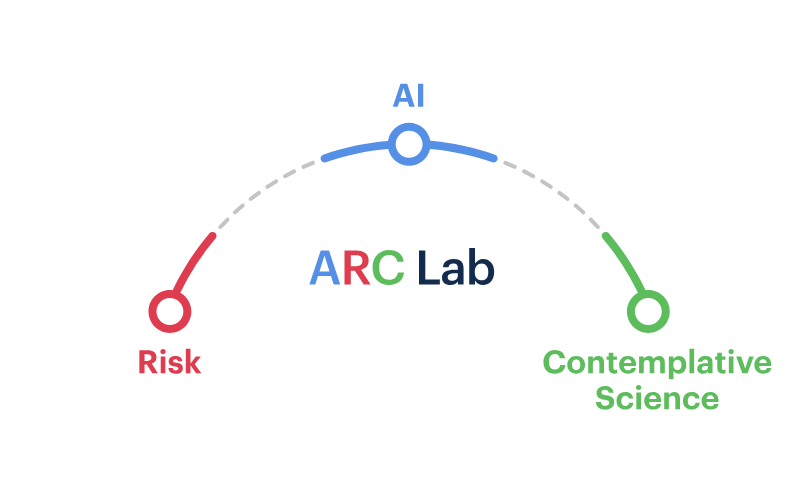
AI, Risk, and Contemplative Science (ARC) Lab
Using data science to analyze people’s speech and language across the arc of mental health, from psychological risk to contemplative flourishing.
About Our Work
The ARC Lab studies mental health by using computational methods to analyze speech and language data found in clinical interviews, social media, journals, and chatbot conversations. We develop novel and equitable assessments and interventions using natural language processing, large language models (LLMs), speech processing, machine learning, psychometrics, and causal inference.
Our work aims to understand psychological risk and contemplative states by evaluating both an individual’s’ phenomenology — their first-person subjective experience — and more objective and standardized measures.
Our Application Areas

Identifying Risk
We study suicide risk, the impact of social media on mental health, and the risk of AI chatbots when used for psychological support.

Contemplative Science
We study how meditation, psychedelics, and journaling move people from risk to flourishing through acceptance, insight, and compassion.
Risk Research
Text Psychometrics
We develop methods for evaluating the validity and reliability of text-based psychological assessments. Our research has identified which symptoms indicate the highest risk of suicide from crisis hotline conversations and social media posts. We created an open-source toolbox that uses LLMs to measure and validate symptoms like these.
Voice and Speech Biomarkers
We examine how voice changes across mental health conditions. Our work focuses on detecting speech changes that occur as hospitalized and recently discharged individuals become more suicidal, with the goal of improving risk assessments.
The Risk of AI Chatbots for Mental Health
We study how to regulate and evaluate AI chatbots when users are suicidal. Our current work explores whether AI chatbot users are able to recognize when suicidal and delusional concerns should be challenged rather than validated during AI chatbot interactions.

Selected Risk Research Papers
Low DM, Rankin O, Bentley KH, Nock MK Ghosh SS (2026)
Khazanov G*, Franz PJ*, Stade EC, Kelly D, Poerio MJ, Maitlin C, Emery K, Low DM, …, Wiltsey Stirman S (2026)
Low DM, Rumker, L, Talkar T, Torous J, Cecchi G, Ghosh SS (2020)
Damiano RF, Low DM, Ito LT, Santoro ML, Belangero S, Pan PM, Casella C, Schäfer JL, Blumberg HP, Miguel EC, Rohde LAP, Salum GA (2026)
Contemplative Science
Journaling
The Child Mind Institute’s Mirror journaling app, which serves as a privacy-preserving phenotyping tool to assess suicide risk, circadian rhythms, energy, arousal, and mood, has been shown to reduce anxiety. Our ongoing research explores the similarities and differences between meditation and journaling.
Psychedelics, Mindfulness, and Insight
Mindfulness and other psychological factors help explain changes in mental health following naturalistic psychedelic use. We are currently testing whether mindfulness meditation can reduce stress in low-income populations. We are also exploring the emergence of insight and its effects after psychedelic use, as well as strategies for reducing harms associated with its use.
Limits of AI for Existential Concerns
Chatbot users often turn to AI for support with existential and spiritual concerns related to meaning, purpose, and death. We are investigating the potential and limits of AI in providing guidance in these domains.
Selected Contemplative Science Papers
Milham MP, Low DM, Erkent A, Trabulsi J, Kass M, Vos de Wael R, Yenepalli S, Wang Y, Leyden M, Jordan C, Salum GA, Alexander L, Schubiner G, Hendrix L, Koyama MS, Mears L, McAdam R, White C, Merikangas K, Satterthwaite TD, Franco AR, Klein A, Koplewicz H, Leventhal B, Freund M, Kiar G (2026)
Kim M, Low DM, Lafond D, Shim C, Han M, Kandil M, Zhang C, Kitsberg T, Boccagno C, Liang PP, Maes P (2026)
Herrmann FH*, Jones G*, Low DM, Carhart-Harris R, Kettner H (2025)

Collaborate With Us
If you are interested in exploring a collaboration or volunteer internship, please fill out our inquiry form. You can also explore our current network of collaborators.
Our Team

Daniel Low, PhD
Research Scientist, Center for Data Analytics, Innovation, and Rigor (DAIR)

Camilla Strauss
Data Analyst, Center for Strategic Data Initiatives (SDI); Center for Data Analytics, Innovation, and Rigor (DAIR)

Freymon Perez Paulino
Data Analyst, Strategic Data Initiatives (SDI); Center for Data Analytics, Innovation, Rigor (DAIR)

Meghan Ryan
Research Assistant, Center for Strategic Data Initiatives (SDI); Center for Data Analytics, Innovation, and Rigor (DAIR)