Blog
Across Generations: Reflections on the Second Annual Global Summit on Youth Mental Health

The second annual Global Summit on Youth Mental Health led by the Stavros Niarchos Foundation (SNF) Global Center at the Child Mind Institute was held during the 81st United Nations General Assembly Week in New York. The opening remarks at this event reminded us that systems are often built for young people without them sitting at the table. Looking back, the whole week felt like a shared effort to change that. Young people and experts from around the world engaged in important conversations that combined science research with advocacy and lived experience.
From beginning to end, the summit was co-organized by the Global Youth Advisory Council (GYAC) at the SNF Global Center. Its members hail from Brazil, Greece, and South Africa: Jennifer Matibi, Kayla Coetzer, Spyros Chronis, Faidra Kamperidi, Mariana Chaves and Denny Oliveira Curini. The chosen theme was “Redefining Mental Health Care: Youth Perspectives in a Changing World” and the event featured panels, workshops, breakout sessions, new research, and interactive activations. The issues that affect young people’s mental health are complex, and complexity demands collaboration.
A dedicated youth networking hour preceded the main summit program on September 24, welcoming the participation of professionals from different organizations. Throughout the week, I had the chance to meet young people and experts from more than 30 countries, all working to push the needle forward for youth mental health. The atmosphere was teeming with collaboration and a deep sense of respect.
Many ideas came to life during the panels and sessions. There was a concrete sense of unity, with GYAC members in meaningful conversations with partners from many organizations including UNICEF, the JED Foundation, Grand Challenges, and the McKinsey Health Institute. Guest speakers also included Shudufhadzo Musida, author, advocate, and UNFPA Global Champion for Women and Girls.
The first panel discussion, “Meeting Young People Where They Are: Bringing Mental Health Support in Schools,” explored the role of schools in redefining mental health care. It was creatively introduced with storytelling from Denny (Brazil) and Kayla (South Africa). The session covered school cultures, how what we measure and reward in academic environments can affect young people’s mental health, and how much it matters for students to be surrounded by a strong network of supportive relationships.
Throughout the morning, we also heard profound discussions on social media and political instability, two of the many pressures young people navigate in an increasingly connected and uncertain world. The panel “Where Young People Connect, Create, and Share: Redefining Youth Mental Health in the Digital Context” highlighted that while conversations about young people and technology tend to focus on the risks, digital spaces are also where many young people express themselves and look for help when they’re struggling. Making these spaces safer should start from the way they are designed, and young people themselves should be involved in shaping them. This topic was later re-addressed during the fireside chat between moderators Kayla and Jennifer (South Africa) and guest speaker Shudufhadzo Musida, who discussed self-care and setting boundaries when advocating for mental health. She also talked about the importance of creating a safe space online for people to reflect and learn about mental health.
Later in the day, the spotlight session “From Aspiration to Action: Reimagining Community Wellbeing” looked at youth mental health from a systems perspective — considering the myriads of factors and stakeholders involved in supporting young people and how mental health support can be reimagined and grounded in communities. The session also reflected on the idea that community well-being cannot be strengthened at scale by one organization alone, and that partnerships are essential to make progress.
With the summit taking place during the same week as the UN General Assembly and Climate Week, the whole of New York City was buzzing. Everything felt like one continuous exchange. During the breaks, I had the chance to reconnect with colleagues and meet many new people working in the field of youth mental health. Two of those conversations have stayed with me, because they both pointed to the same idea: the power of intergenerational dialogue.
Emma Beckwith, a young leader who joined the Child Mind Institute’s Youth Mental Health Academy (YMHA) to work closely with the SNF Global Center during the summer, reminded me that if we want to address the disparities in child and adolescent mental health around the world, going to young people, learning from their lived experience, and working alongside adults to turn ideas into change is essential. And Felipe Paullier, MD, Assistant Secretary General for Youth Affairs at the UN Youth Office, pointed out that young people have a critical role in changing how we approach mental health. He stressed that bringing varied generations into the conversation is also fundamental. These experts come from different seats at the same table. So, hearing them both relay essentially the same message made it resonate stronger for me.
There is so much I am taking home from the summit week. It began with a series of workshops co-hosted with United for Global Mental Health (UGMH). And as an SNF Global Center Communicator Fellow, I co-led a workshop on communications and advocacy with Dave Gill and my fellow colleagues Naomi Grewan and Mary Ann Nobele from Radio Workshop. It was inspiring to see so many people using their own stories to positively influence change in youth mental health care. Stories are powerful, and they are one of the best ways to motivate change.
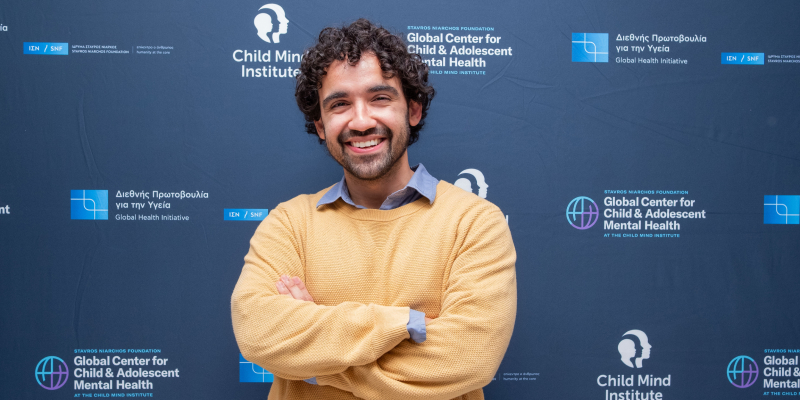
Communicator Fellow, Brazil, SNF Global Center at the Child Mind Institute
One moment I keep coming back to is seeing João Marcos Almeida dos Santos, a Brazilian youth counselor for Gentilmmente — a project supported by the SNF Global Center’s Child and Adolescent Mental Health Initiative (CAMHI) in Brazil — talk about challenges the digital environment poses to youth mental health. João also won the nationwide Single Session Intervention (SSI) competition, a partnership between CAMHI Brazil and the Felipe Neto Institute that invited young Brazilians ages 16–20 to share their vision for advancing youth mental health through healthier technology habits. Dos Santos highlighted the need for expanded psychosocial support in schools across Brazil:
Schools in Brazil, for example, often don’t have psychologists or counselors to support students. Teachers aren’t always equipped with the necessary resources to support students who are struggling,” said Dos Santos. “Bullying still happens without structured protection in schools. Students are still under pressure from comparison, along with many other sources of distress. We need to implement more psychosocial support in schools, because that’s exactly where young people are and where they need help the most.
His presentation was delivered in Portuguese and translated in real-time. It was inspiring to see him on stage, raising awareness in his own language, and being able to connect with everyone in the room. For me, that is what powerful youth engagement looks like.
As said by Giovanni Abrahão Salum, MD, PhD, senior vice president of Global Programs during opening remarks, “For us, youth engagement is a condition for quality.”
I am deeply grateful to the GYAC and to everyone at the SNF Global Center who made this summit possible. Now that I am back in São Paulo, after connecting with so many people and reflecting on new learnings, one principle is clearer than ever: youth engagement and intergenerational dialogue are critical conditions for meaningful change in child and adolescent mental health care.