What Parents Should Know About Concussions
And how to minimize the risk of serious injury
en EspañolParents often worry that their children risk serious brain injury by playing high-impact sports like football, soccer, and hockey. If you are among them, you are right to be concerned, since children’s brains are especially vulnerable because they are still developing.
Many young athletes suffer a concussion at some point. Fortunately, most children recover in a few days to a few weeks. But kids who don’t rest effectively may be risking a longer recovery time.
Here’s what you should know about concussions:
What is a concussion?
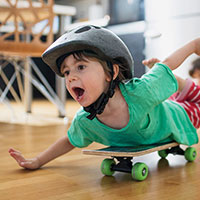
A concussion occurs when the brain experiences blunt trauma serious enough to interfere temporarily with its functioning. A jarring blow to the head and hitting the ground are both common causes among children. Concussions are closely associated with football and hockey, but kids can receive concussions playing any high-impact sport, including soccer, basketball, and volleyball. Cheerleading, gymnastics, skateboarding, and even riding a bike can also cause them.
How do you know if your child has had one?
Signs of concussion include headache, dizziness, nausea, slurred speech, vomiting, amnesia and unconsciousness, although it is possible to sustain a concussion and experience only one or two symptoms. Contrary to popular belief, a child can have a concussion without ever becoming unconscious. Symptoms that may appear hours, or even days, later include difficulty concentrating, sensitivity to light, irritability, difficulty sleeping, and depression. Studies show that girls are more susceptible to concussions than boys.
Some schools are now using the same system to more effectively detect brain injuries that the NFL has adopted. Before play, students are given an online test called ImPACT, a neurcognitive assessment tool that measures their memory and reaction time. Then, if a concussion is suspected, the athlete takes the test again; poorer memory or slower response time can spotlight a brain injury that should keep them out of play.
What should you do if you see signs of a concussion?
If you notice any symptoms, immediately stop your child’s play and seek medical attention.
It is important to allow a concussion to heal fully. Appropriate rest is essential until all symptoms have disappeared, as returning to sports too soon may exacerbate symptoms and prolong recovery time. That means not only avoiding physical activities, but also activities that stimulate the brain, like video games, television, and even texting. Places with bright lights and noise can also impede a child’s recovery. Your child’s doctor will recommend the correct precautions, and your child should be cleared by a physician before he returns to play.
Always see a doctor if you notice that your child’s symptoms are getting worse. Some children experience something called “post-concussion syndrome.” For weeks or even months after sustaining a concussion these kids will be dizzy, lethargic, and unable to concentrate. Post-concussion syndrome makes homework and attending school very difficult.
Learn more about our Family Resource Center and our editorial mission.
Was this article helpful?
Related Reading
-
 My son wants to play football, but we’re worried about the risk of concussions. How can we keep him safe?
Collision sports do carry risk, so get to know the safety guidelines
My son wants to play football, but we’re worried about the risk of concussions. How can we keep him safe?
Collision sports do carry risk, so get to know the safety guidelines
-
 What Is a Neuropsychological Evaluation?
We try to determine how your child learns best.
What Is a Neuropsychological Evaluation?
We try to determine how your child learns best.
-
 Inside an Evaluation for Learning Disorders
Dr. Matthew Cruger walks us through the process
Inside an Evaluation for Learning Disorders
Dr. Matthew Cruger walks us through the process
-
 Complete Guide to Managing Behavior Problems
When children struggle with their behavior, it can have a negative impact on everyone in…
Complete Guide to Managing Behavior Problems
When children struggle with their behavior, it can have a negative impact on everyone in…
-
 Talking to Kids About Alcohol and Drugs
Strategies to help teenagers make good decisions
Talking to Kids About Alcohol and Drugs
Strategies to help teenagers make good decisions
-
 Treating Anxiety in Kids by Working With Parents
In SPACE, children make gains as the therapist works with their parents
Treating Anxiety in Kids by Working With Parents
In SPACE, children make gains as the therapist works with their parents
-
 Choosing a Parent Training Program
How to tell which one is right for you
Choosing a Parent Training Program
How to tell which one is right for you
-
 Family-Based Treatment for Eating Disorders
The parents’ role in helping children recover
Family-Based Treatment for Eating Disorders
The parents’ role in helping children recover
-
 Should Kids Take Mental Health Days?
When taking a break is helpful (and when it's not)
Should Kids Take Mental Health Days?
When taking a break is helpful (and when it's not)
-
 National Children’s Mental Health Report Card
A measure of concerned parents and struggling kids
National Children’s Mental Health Report Card
A measure of concerned parents and struggling kids
-
 How to Talk to Your Teen About Prom
Starting conversations about curfews, budgets, drinking, and more
How to Talk to Your Teen About Prom
Starting conversations about curfews, budgets, drinking, and more